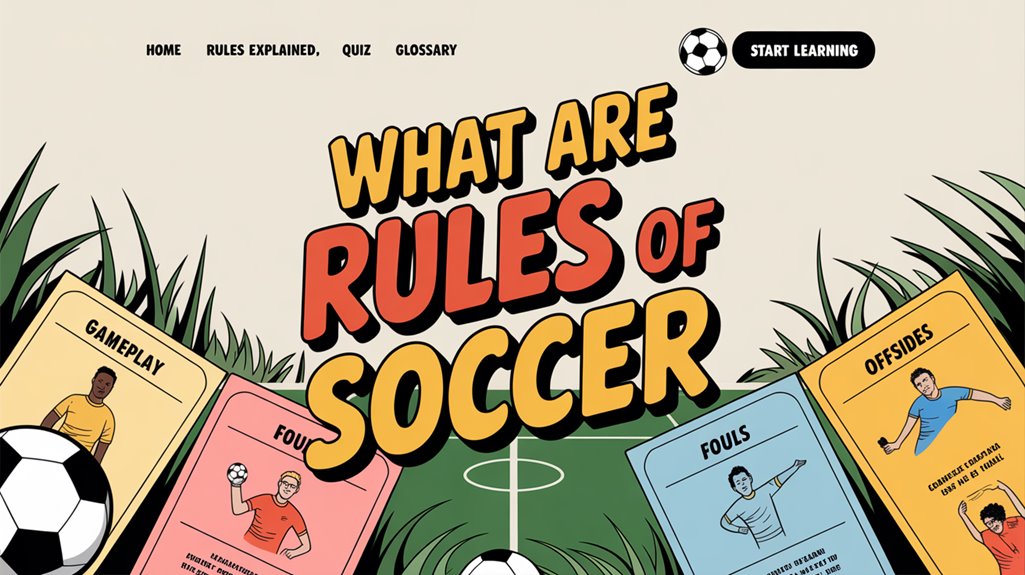
The rules of soccer, established by the International Football Association Board (IFAB), dictate all elements of the game to guarantee fairness and uniformity. Key aspects include field dimensions, match structure, player conduct, and the offside rule. Each match consists of two halves of 45 minutes, with potential additional time. Scoring occurs when the entire ball crosses the goal line. Understanding these regulations is vital for appreciating the game’s intricacies and strategies involved. More details can enhance this foundational knowledge.
Soccer, a globally celebrated sport, operates under a specific set of rules known as the Laws of the Game. These rules, formulated by the International Football Association Board (IFAB), govern all aspects of play, ensuring fairness and uniformity across competitions. Each game is played under the oversight of a referee, whose role includes enforcing these laws and maintaining order on the field.
One fundamental law involves the dimensions of the field. A soccer pitch must be rectangular, with lengths between 100 to 110 meters and widths from 64 to 75 meters for international matches. The goals must be situated at the center of each end, measuring 7.32 meters wide and 2.44 meters high. This standardized layout is essential for uniform play. An additional consideration for modern matches is the increase in allowed substitutions during games, which reflects evolving strategies in the sport.
Another significant aspect is player conduct. Each team consists of eleven players, including a goalkeeper. Fouls may result in free kicks or penalty kicks, depending on the severity and location of the infraction. More serious offenses can lead to yellow or red cards, which penalize players by cautioning them or expelling them from the match, respectively. The accumulation of cards can impact player availability for future games and reflects the importance of understanding foul play on the field. Referees utilize these yellow and red cards to ensure discipline during gameplay.
Offside is a vital rule that influences scoring and strategy. A player is adjudged offside if they are nearer to the opponent’s goal line than both the ball and the second-last opponent when the ball is played to them. This rule aims to prevent goal-hanging and maintain competitive balance, as the offside rule is essential for ensuring fair play in every match.
Scoring occurs when the entire ball crosses the goal line between the goalposts. The match lasts for two halves of 45 minutes, with additional time as determined by the referee. In case of a tie, some competitions might require extra time or penalty shootouts to determine a winner. Additionally, there are specific rules regarding direct kicks awarded for certain fouls, which can significantly impact the game’s outcome.
These extensive regulations permit the sport to maintain integrity and competitiveness, enabling players and teams to showcase their skills within a defined structure. Understanding these rules deepens appreciation for soccer as an intricate and strategic game.
Frequently Asked Questions
How Long Is a Standard Soccer Match Typically Played?
A standard soccer match is typically played for 90 minutes, divided into two equal halves of 45 minutes each. Additional time may be added for stoppages, but the core duration remains unchanged.
What Equipment Is Required to Play Soccer?
To play soccer, essential equipment includes a size-appropriate soccer ball, shin guards for protection, cleats for traction, and uniforms comprising jerseys and shorts. Goalkeepers also require specialized gloves and padded clothing for safety.
How Many Players Are on a Soccer Team?
The question involves the number of players on a soccer team. Typically, each team consists of eleven players, including one goalkeeper and ten outfield players, forming a balanced unit to compete in the sport.
What Is the Offside Rule in Soccer?
The offside rule is a regulation designed to prevent attacking players from gaining an unfair advantage. A player is offside when positioned closer to the opponent’s goal line than both the ball and the second-to-last defender.
How Are Penalties Awarded in Soccer?
Penalties in soccer are awarded when a player commits a foul within the penalty area. The referee makes the decision based on the severity of the infraction, allowing the opposing team a chance to score directly.