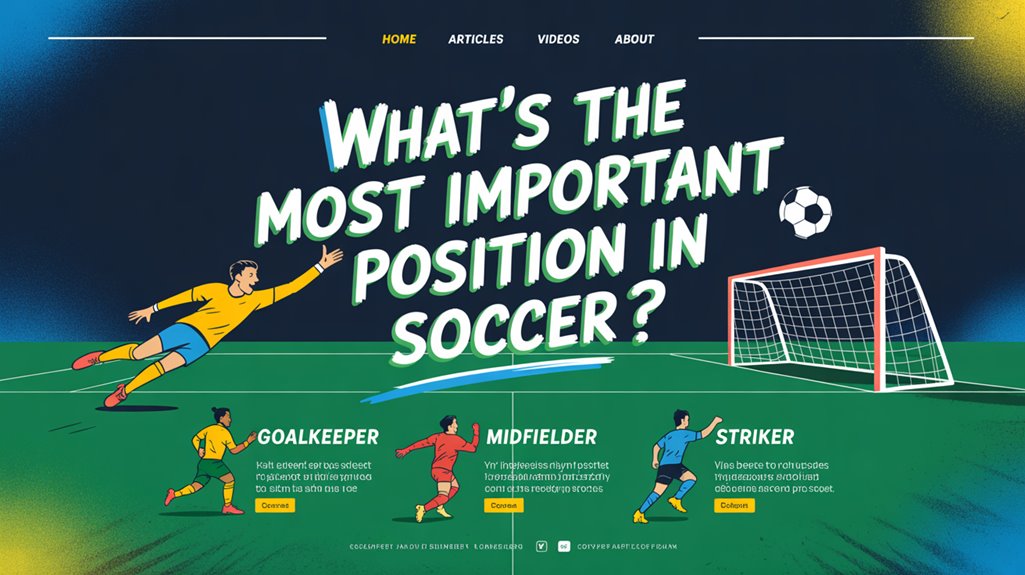
In soccer, the question of which position is most important cannot be definitively answered. Each role, from goalkeeper to forward, fulfills an essential function in achieving team success. Goalkeepers initiate plays and prevent goals, while defenders maintain formation and block attacks. Midfielders link defense with offense, orchestrating gameplay. Forwards focus on converting chances into goals. The interplay of these roles greatly influences match outcomes. Understanding each position’s contribution enhances appreciation for the game’s complexity and strategy.
In soccer, the debate over the most significant position is often contentious, as each role contributes uniquely to the team’s overall performance. Among these positions, the goalkeeper frequently emerges as a focal point of discussion. This is primarily due to the distinct responsibilities associated with the role, which encompass shot-stopping, organizing the defense, and initiating offensive plays.
Goalkeepers possess unique skills that can deeply impact game outcomes. Their primary duty is to prevent the opposing team from scoring, which requires quick reflexes and exceptional decision-making abilities. A single error can lead to a decisive goal, placing immense pressure on this position. The position demands intense mental fortitude due to its high-stakes nature and critical decision-making requirements. Particularly, renowned goalkeepers such as Gianluigi Buffon and Manuel Neuer are often celebrated for their outstanding performances during critical moments, reflecting the heightened stakes associated with their role.
Goalkeepers’ unique skills and quick decision-making can decisively influence game outcomes, as illustrated by legends like Buffon and Neuer.
However, the significance of the defender position cannot be understated. Defenders are tasked with blocking attacks, maintaining the formation, and ensuring communication within the defensive unit. They form the backbone of a team’s strategy, often dictating the pace and rhythm of the game from the back line. Center backs excel at physical battles with opposing forwards while protecting the goal. Successful defenders, such as Franco Baresi and Paolo Maldini, often provide the foundation upon which the team operates, showcasing the essential nature of their contributions. Modern defenders excel at initiating offensive plays through strategic ball distribution to teammates in advanced positions.
Similarly, midfielders play an important role in balancing defense and offense. They serve as the link between defenders and forwards, orchestrating the flow of play. A central midfielder’s vision and passing accuracy are crucial for creating scoring opportunities. The defensive midfielder, or number 6 position, acts as the team’s tactical anchor by breaking up attacks and maintaining stability. Players like Andrea Pirlo and Xavi Hernández exemplify how effective midfielders can alter matches with their tactical intelligence and skill, highlighting their indispensable nature.
Finally, forwards or strikers are fundamental for converting chances into goals. They are expected to have exceptional finishing skills and the ability to read the game. They are often seen as the focal point of the attack and can define a team’s success in critical matches. Their success relies heavily on quick positioning to create scoring opportunities near the opponent’s goal.
Frequently Asked Questions
How Do Player Formations Impact the Importance of Positions?
Player formations greatly influence position importance, as some strategies prioritize attackers for scoring, while others emphasize defenders for stability. This shift alters team interactions, requiring adaptability and showcasing varying roles based on tactical approaches.
Can a Single Player Change the Game’s Outcome in Soccer?
A single player can greatly influence a soccer game’s outcome. Their skill, decision-making, and ability to perform under pressure often determine the game’s direction, showcasing how individual talent can alter team interactions and ultimate results.
What Skills Are Essential for Each Soccer Position?
Each soccer position requires specific skills; forwards excel in finishing and positioning, midfielders focus on passing and vision, defenders prioritize tackling and awareness, while goalkeepers need reflexes and shot-stopping ability for effective play.
How Do Different Leagues View Positional Importance Differently?
Different leagues prioritize positional importance based on their playing styles and strategies. For instance, attacking-focused leagues may value forwards highly, while defensively-minded leagues might emphasize the role of central defenders and goalkeepers in their tactical structures.
What Is the Historical Evolution of Soccer Positions?
The historical evolution of soccer positions reflects tactical shifts and innovations. Initially, players occupied loose roles but gradually specialized, forming distinct positions like forwards, midfielders, and defenders, influenced by changing game interactions and strategic developments over time.