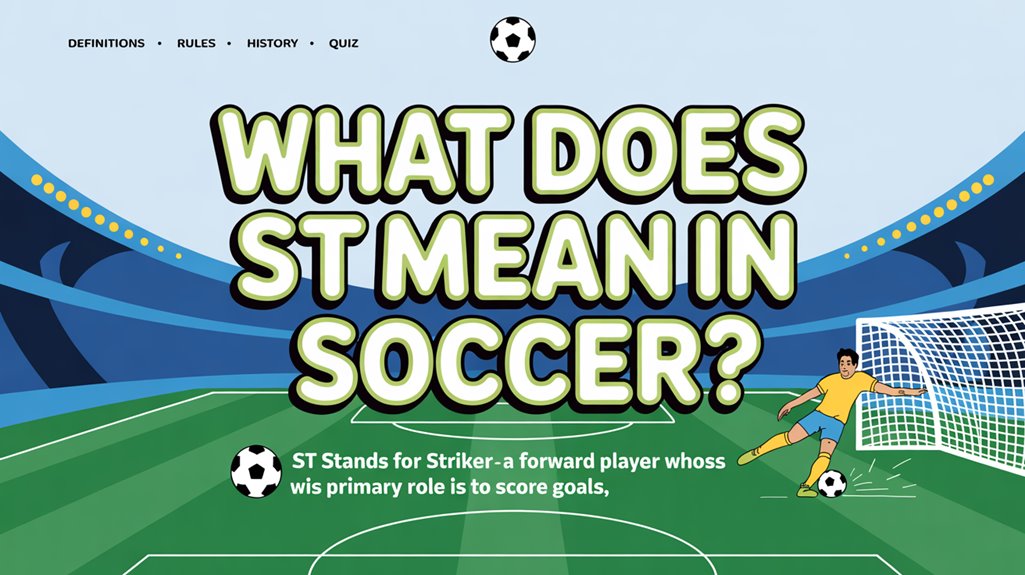
In soccer, “ST” refers to Striker, a critical position focused on scoring goals. Positioned near the offensive end, strikers are tasked with converting scoring opportunities. They require speed, agility, and strong technical skills. Effective communication with teammates enhances their ability to create chances. Strikers often work alongside wingers and attacking midfielders in formations like 4-4-2 or 4-3-3. Understanding the significance of the Striker’s role informs broader team interactions and tactical strategies. Further exploration reveals additional perspectives.
In soccer, the abbreviation “ST” stands for “striker,” a significant position on the field responsible for scoring goals. Strikers play near the offensive end and are primarily tasked with converting opportunities into goals. The role demands a combination of speed, agility, and technical skill, as they often need to outmaneuver defenders while maintaining possession of the ball under pressure. Effective communication with teammates, particularly midfielders, is essential for creating scoring chances.
Strikers typically operate within a formation that supports their goal-scoring objectives. Common formations that deploy strikers include the 4-4-2 and 4-3-3. In these setups, the striker‘s positioning is strategic, as it allows for both individual skill and team interactions to shine. They often work in tandem with wingers and attacking midfielders to maximize offensive potential. Unlike demanding midfielder roles, strikers can focus more on offensive positioning rather than covering extensive ground across the entire pitch. Their coordination with ball distribution specialists helps create effective attacking plays. Similar to center forwards, strikers must possess excellent finishing skills to consistently convert scoring opportunities.
Strikers thrive within formations like 4-4-2 and 4-3-3, leveraging teamwork and individual skill to enhance their scoring abilities.
Unlike defensive midfielders who act as tactical anchors, strikers have more freedom to focus on attacking movements and goal-scoring opportunities. In professional soccer, the role of the striker extends beyond mere goal scoring. A proficient striker is expected to understand various aspects of the game, such as positioning, timing, and tactical awareness. They must anticipate plays and react quickly to maximize their chances of receiving the ball. Their physical attributes, including strength and aerial ability, are often critical in duels against defenders, further enhancing their effectiveness on the pitch.
Moreover, strikers are analyzed through various metrics that assess their performance. These can include the number of goals per match, assists, shot accuracy, and involvement in build-up play. Coaches and analysts rely on these statistics to gauge a striker’s efficiency and impact on the game.
To summarize, the “ST” designation in soccer epitomizes a role of considerable importance within team interactions. Strikers are essential to a team’s attack and overall success. Understanding their responsibilities and contributions provides understanding into the broader tactical structure of soccer. Recognizing the diverse nature of the striker position allows for a deeper appreciation of the sport. Quick shots on target are crucial skills that strikers must master to consistently create scoring opportunities.
Frequently Asked Questions
What Are the Characteristics of a Good ST in Soccer?
A proficient forward displays exceptional goal-scoring ability, sharp positioning, strong physical presence, and effective communication with teammates. Additionally, adaptability, quick decision-making, and a keen understanding of the game greatly enhance their impact on the field.
How Does an ST Contribute to a Team’s Formation?
An ST considerably influences a team’s formation by providing depth in attack, creating spacing for midfielders, and challenging defensive lines. Their positioning often dictates opposing defensive strategies, enhancing overall team interactions and effectiveness in offensive play.
Can an ST Play Other Positions Effectively?
An ST can effectively play other positions due to their versatility, agility, and understanding of the game. Their skills often translate well, allowing them to adapt to various roles, contributing uniquely to a team’s interactions.
What Skills Are Essential for an ST to Succeed?
Essential skills for a successful striker include excellent finishing ability, strong positioning, agility, speed, and an understanding of tactical movements. Effective communication and teamwork also contribute greatly to their overall performance on the field.
Who Are Some Famous Soccer Players Known as STS?
The inquiry into notable soccer players recognized as strikers led to names like Thierry Henry, Ronaldo Nazário, and Gabriel Batistuta, each celebrated for their extraordinary goal-scoring abilities and contributions to the sport throughout their careers.