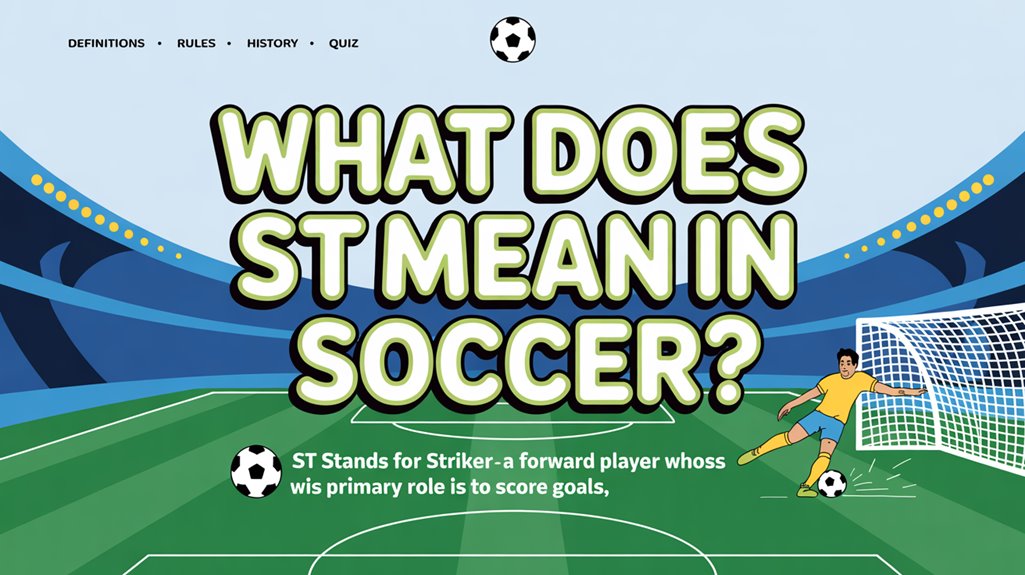
In soccer, the abbreviation “ST” identifies the position of a striker. This role is crucial as it focuses on scoring goals and acts as the fundamental hub of a team’s attacking efforts. Strikers are positioned at the front, utilizing technical skill and tactical awareness to evade defenders. Their effectiveness often influences overall team performance, making the position essential in match outcomes. Further exploration reveals the intricacies and advancing expectations surrounding this role in modern soccer.
In soccer, the abbreviation “ST” denotes the position of striker. The striker is an essential role within a team’s formation. Typically positioned at the front, the striker’s primary responsibility is to score goals. This role demands a combination of technical skill, speed, and tactical awareness. Strikers often serve as the focal point of a team’s attacking efforts, relying on their ability to finish opportunities created by teammates.
The striker, or “ST,” is vital in soccer, responsible for scoring and leading a team’s attack.
Strikers are usually characterized by their proficiency in shooting and heading the ball. They must exhibit the ability to convert chances from various angles and distances. This skill set often distinguishes a successful striker from merely adequate players. Additionally, a striker is often required to possess strong positioning and movement skills, enabling them to elude defenders and find space for scoring opportunities. Similar to a center forward position, strikers must demonstrate excellent finishing abilities and tactical intelligence. Their technical ability allows them to influence the outcome of matches considerably. Consistent practice drills help strikers develop and maintain their essential shooting skills.
In formations commonly employed in soccer, the striker may play alone or alongside other forwards. When playing as a lone striker, they may be supported by attacking midfielders. In tandem striking roles, two strikers can complement each other’s playing styles, maximizing offensive potential. Each striker may possess specialized skills. Some may thrive on speed and agility, while others may employ strength and aerial ability. Effective strikers often rely on midfield support to create scoring opportunities. Successful coaches develop training sessions specifically designed to enhance striker performance and team coordination.
The effectiveness of a striker may determine a team’s overall performance in a match or tournament. Teams often analyze successful strikers from other clubs to inform their tactical strategies. This analytical approach aids coaches and managers in developing game plans that capitalize on their striker’s strengths.
In professional soccer, the importance of the striker position cannot be understated. The success of a team’s season may hinge on its strikers’ performance. As the game evolves, so do the expectations and responsibilities associated with the striker role. The continuous refinement of playing styles necessitates adaptability in strikers to meet the demands of modern soccer. Quick shots on target remain crucial skills for strikers who must capitalize on scoring opportunities when they arise.
Frequently Asked Questions
What Are the Different Positions in Soccer?
In soccer, various positions include goalkeeper, defenders, midfielders, and forwards. Each role has distinct responsibilities, such as preventing goals, maintaining possession, or scoring, contributing collaboratively to a team’s overall strategy and performance on the field.
How Does Player Position Affect Game Strategy?
Player position greatly influences game strategy, dictating team formation and tactical approaches. For instance, an attacking player enhances offensive play, while a defensive player’s role stabilizes the backline, ultimately shaping the team’s overall performance and effectiveness.
What Skills Are Essential for an ST?
Essential skills for a striker include exceptional finishing ability, strong positioning, quick decision-making, effective dribbling, and physical strength. Additionally, awareness of teammates and opponents enhances their overall contribution to a team’s offensive strategy and success.
How Is an ST Different From a CF?
The distinction between an ST and a CF primarily lies in positioning and responsibilities. An ST focuses on finishing and scoring goals, while a CF plays a more active role, facilitating attacks and linking with midfielders.
Can a Goalkeeper Also Play as an ST?
In soccer, while goalkeepers possess the fundamental skills for various positions, they are highly specialized for their role. Shifting to striker is uncommon and typically requires different physical attributes and technical proficiency not usually honed in goalkeeping.